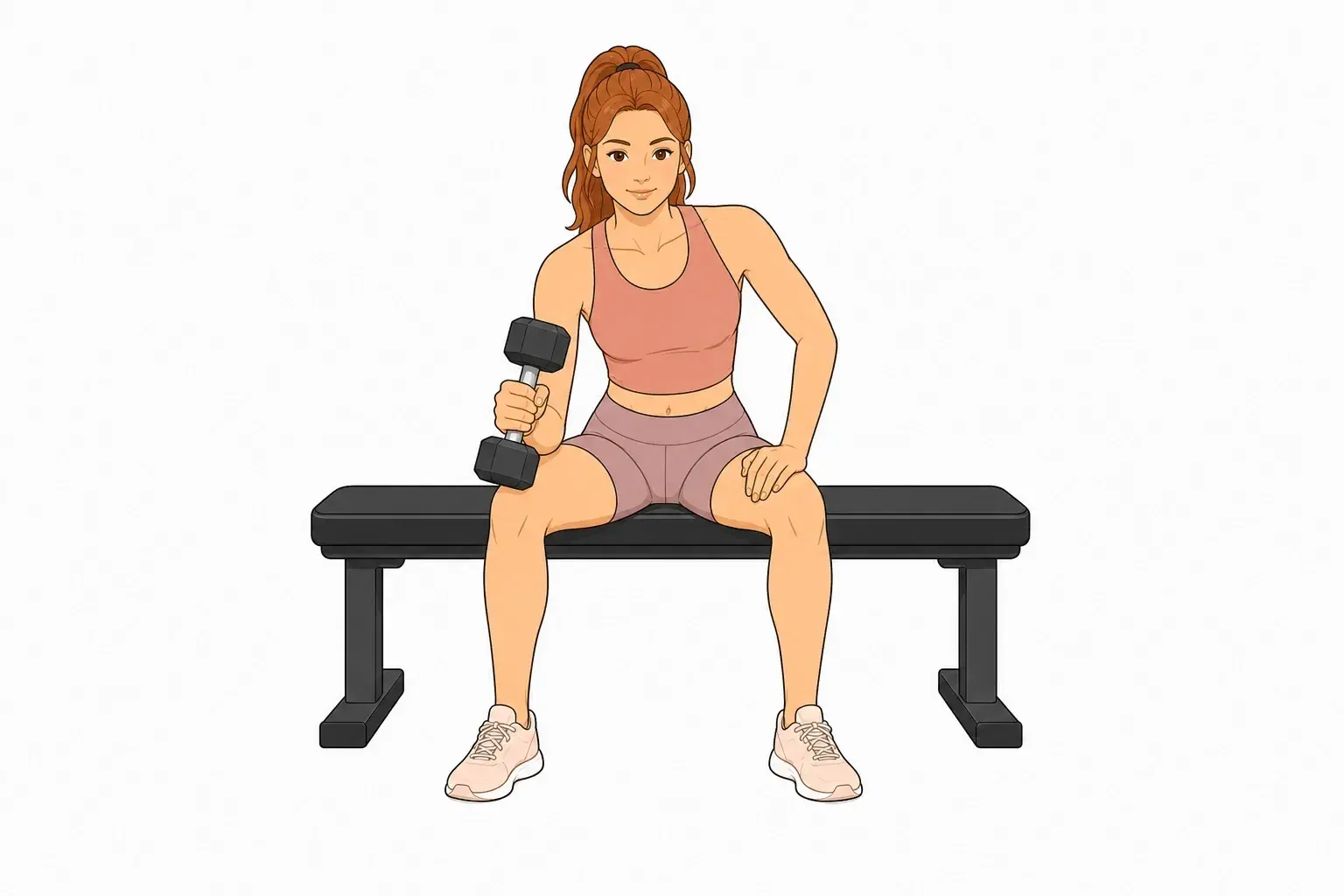

Dumbbell Radial Deviation is a beginner upper body exercise you can do using dumbbell and bench. Below is the full movement, step by step, with the form cues and common mistakes that matter most.
At a glance
| Body area | Upper body |
|---|---|
| Difficulty | Beginner |
| Equipment | Dumbbell, Bench |
| Main muscles | Forearm and wrist extensors |
| Movement pattern | Radial deviation |
| Steps | 2 |
Muscles worked
The work lands mainly on your forearm, with your wrist extensors taking a share of it. If one of those areas is already sore, move Dumbbell Radial Deviation to another day.
The pattern here is radial deviation.
Move the wrist toward the thumb side in a controlled manner to target the radial-side forearm muscles.
How to do it
Step 1
Sit upright and hold a dumbbell vertically in one hand at your side, with your forearm resting on your thigh or a flat surface and your palm facing inward.

Step 2
Move your wrist toward the thumb side in a controlled manner, lifting the outer edge of the dumbbell, then return to the starting position with control.

Form cues
- Sit upright with good posture
- Keep your forearm stable on your thigh or table
- Hold the dumbbell with a neutral grip
- Move only at the wrist; keep your forearm still
- Use a smooth, controlled tempo
- Feel the stretch and contraction on the thumb side of your forearm
Common mistakes
Forearm lifting off the support surface. Press your forearm firmly into the support surface throughout the movement.
Wrist bent backward before starting the movement. Start with your wrist in a neutral, straight position.
Gripping the dumbbell too tightly. Use a relaxed grip; let the dumbbell rest in your hand.
Moving the entire forearm instead of just the wrist. Anchor your forearm to the support surface and move only your hand.
Jerky or bouncing movements. Use a steady, deliberate pace throughout the movement.
Moving too far into radial deviation and straining the wrist. Move through a comfortable range of motion without forcing the end range.
Breathing
- Inhale as you prepare.
- Exhale as you move toward the thumb side; inhale as you return.
How to program it
Reel Motion starts you at 3 sets of 10, with 1 min of rest in between, which comes to about 3 min 30 sec in total. Add sets before you add reps, and reps before you shorten the rest.
| Sets | 3 |
|---|---|
| Reps per set | 10 |
| Rest between sets | 1 min |
| Total time | about 3 min 30 sec |
Safety
- Use a light dumbbell to avoid wrist strain
- Keep your forearm stable to isolate the wrist movement
- Stop immediately if you feel sharp pain in your wrist
Related exercises
More upper body movements in the Reel Motion library:
- Dumbbell Ulnar Deviation — beginner