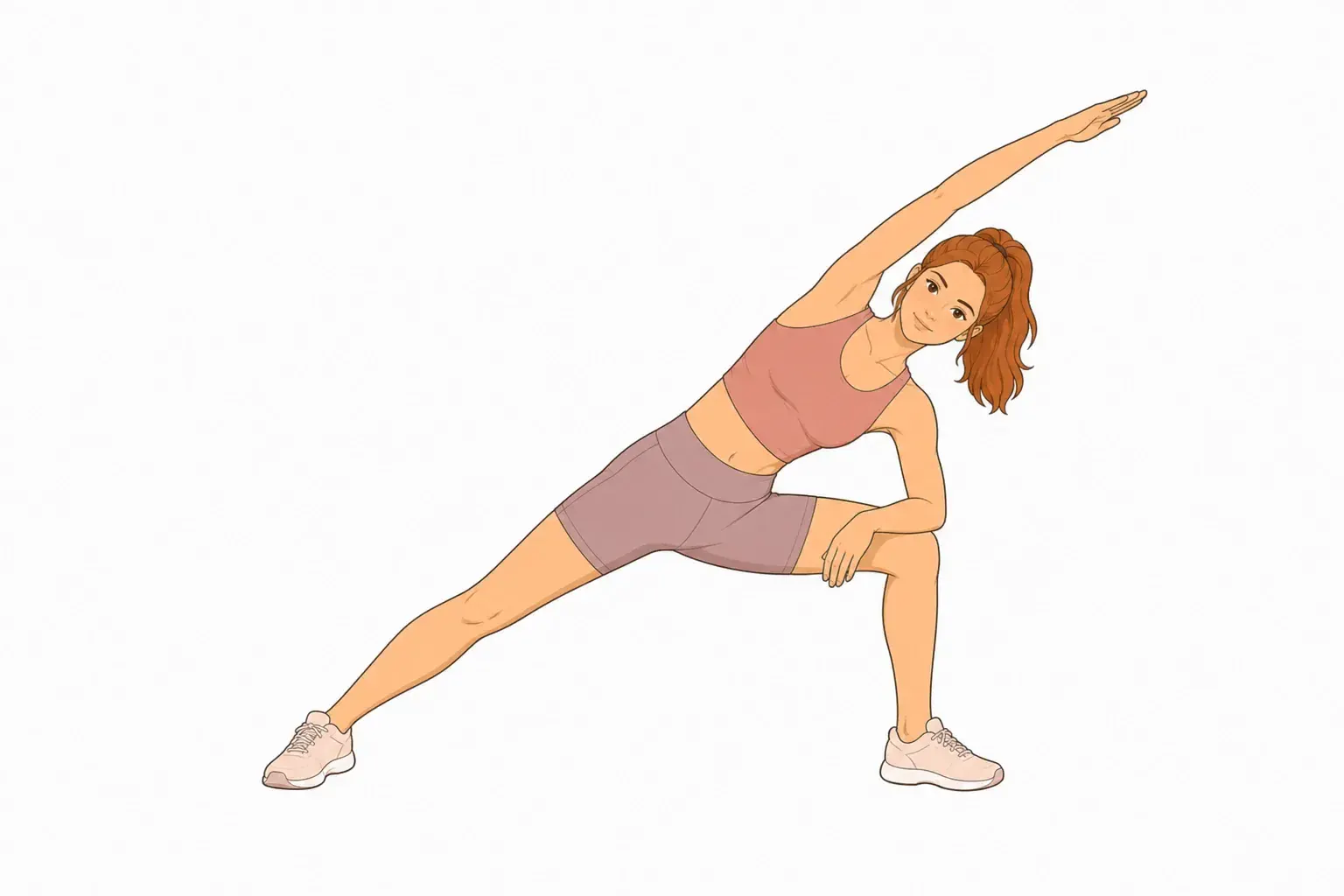

Extended Side Angle Pose is an intermediate lower body exercise you can do with no equipment. Below is the full movement, step by step, with the form cues and common mistakes that matter most.
At a glance
| Body area | Lower body |
|---|---|
| Difficulty | Intermediate |
| Equipment | None — bodyweight only |
| Movement pattern | Mobility |
| Trained | One side at a time |
| Steps | 3 |
Muscles worked
Because you train one side at a time, your core has to stop your hips and shoulders twisting on every rep, and any strength gap between your left and right side shows up immediately instead of being hidden by the stronger side.
The pattern here is mobility. Follow it with a strength movement in the same session and the workout stays balanced.
How to do it
Step 1
Stand with your feet wide apart, turn your front foot out, and angle your back foot slightly inward.
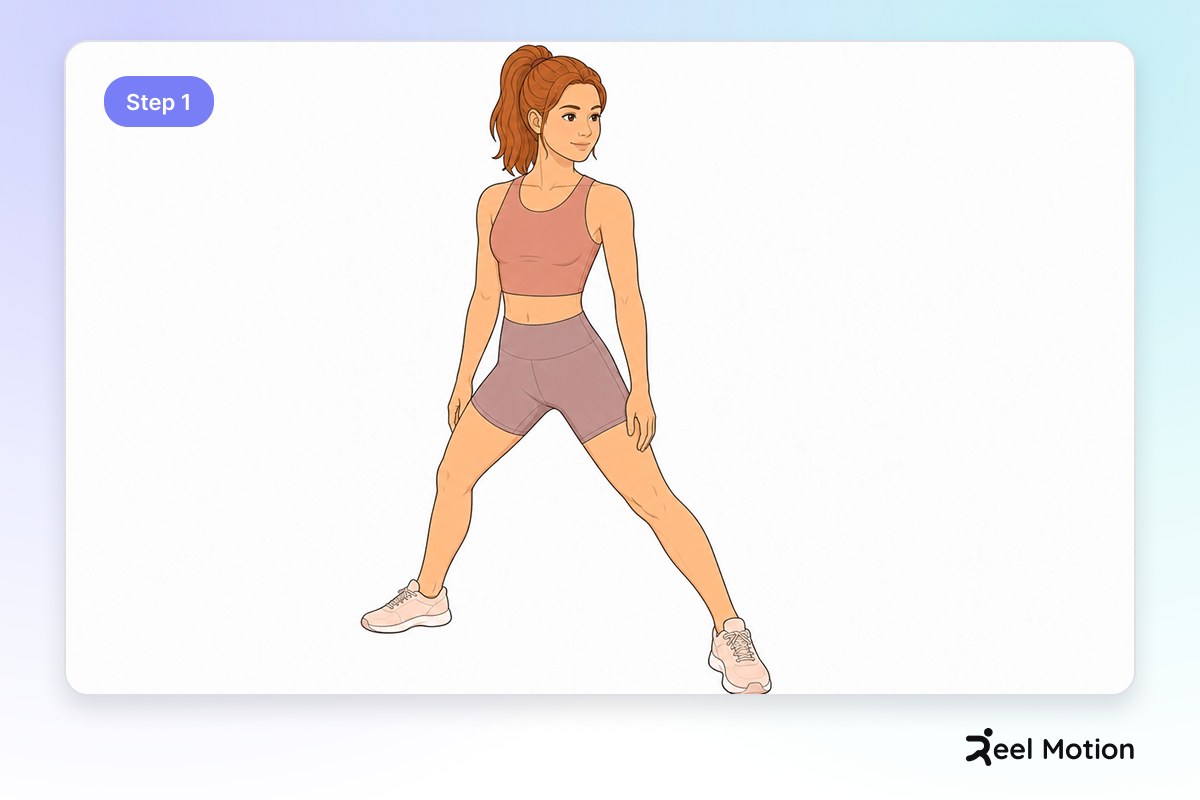
Step 2
Bend your front knee over your ankle until your thigh approaches parallel with the floor, then rest your front forearm on your thigh or bring your hand to the floor outside your foot.
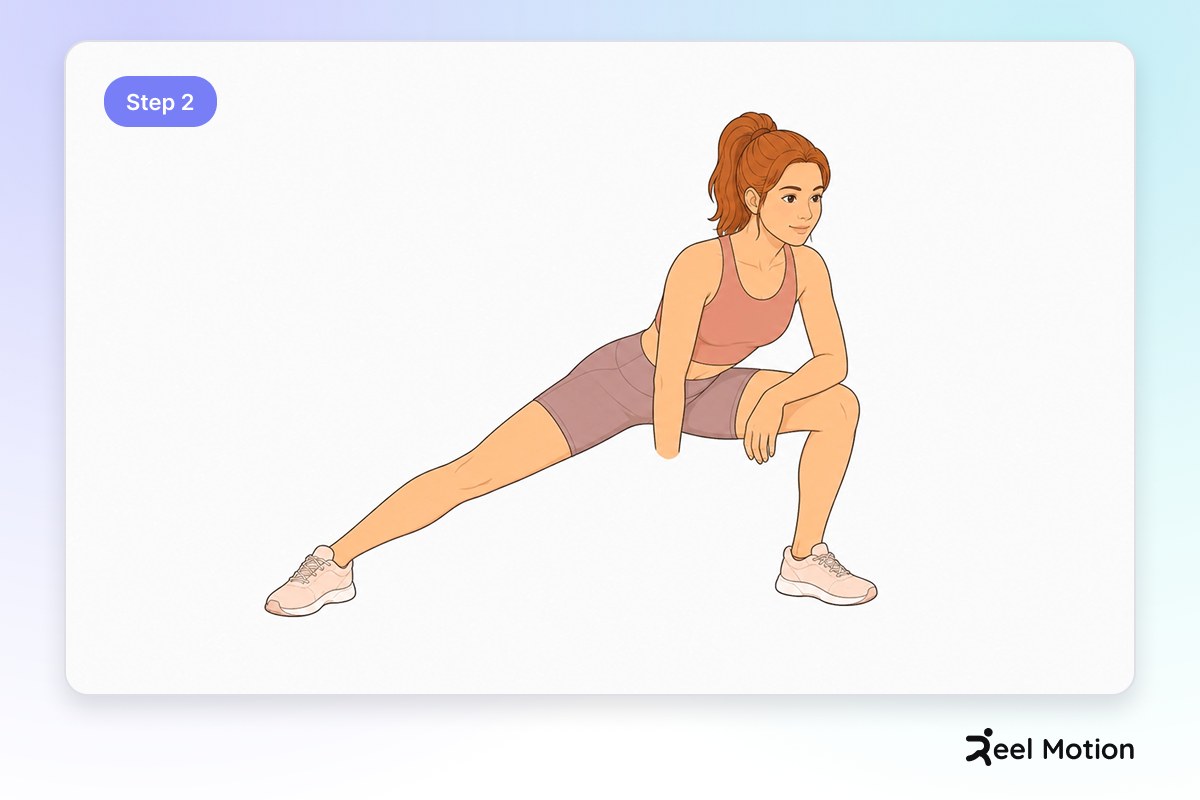
Step 3
Sweep your top arm over your ear so one long line runs from your back heel to your top fingertips.
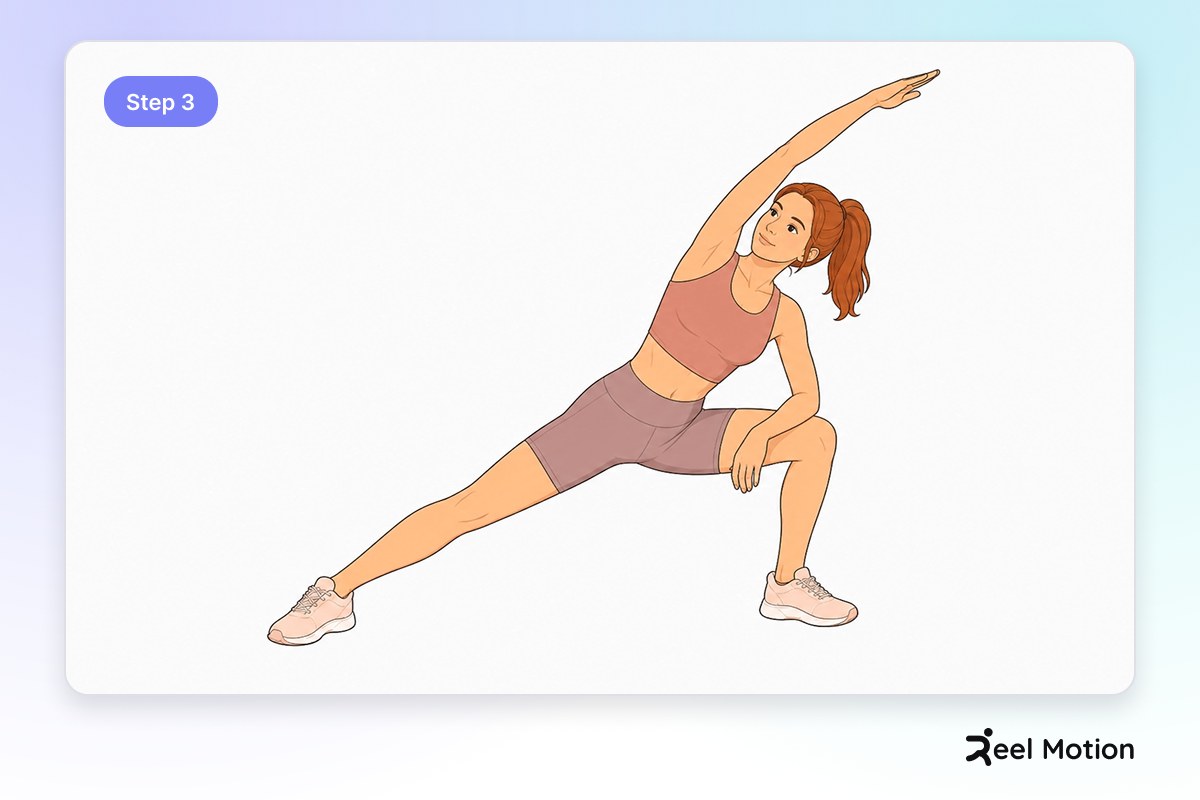
Form cues
- Feet shoulder-width apart or wider
- Front foot turned outward 45 degrees
- Back foot angled inward 15–20 degrees
- Weight evenly distributed
- Front knee stacked over ankle
- Front thigh parallel to the floor
- Torso rotates toward the bent knee
- Forearm rests on thigh or hand on floor outside foot
- Hips stay level and face forward
- Top arm extends overhead alongside your ear
- Shoulders relaxed away from ears
- Spine lengthens from tailbone to fingertips
- Gaze follows your top hand or stays neutral
- Back heel presses firmly into the floor
Common mistakes
Feet too close together. Widen your stance so your front thigh can bend without your knee caving inward.
Front foot pointing straight ahead. Rotate your front foot outward to align your knee over your ankle.
Back foot turned outward. Angle your back foot inward to stabilize your hips and prevent them from rotating forward.
Front knee caving inward. Press your front knee outward to align it over your ankle.
Front knee extending past the toes. Shorten your stance if your knee travels past your toes.
Torso collapsing forward. Engage your core and lengthen your spine as you fold forward.
Hips rotating or tilting. Square your hips forward and press your back heel into the floor to stabilize.
Arm drifting away from the ear. Keep your arm close to your ear and rotate your ribcage open toward the ceiling.
Shoulders hunching toward ears. Draw your shoulders down and back to create length through your neck.
Torso collapsing or rounding forward. Lengthen your spine and engage your core to prevent your torso from folding.
Back heel lifting off the floor. Press your back heel down to anchor your lower body and stabilize your hips.
Breathing
- Exhale as you bend your front knee and fold forward.
- Inhale as you extend your arm overhead; breathe steadily as you hold the pose.
How to program it
Reel Motion starts you at 1 sets of 45 sec per side, with 15 sec of rest in between, which comes to about 45 sec in total. Match the reps on your weaker side first, then give the stronger side the same number and no more.
| Sets | 1 |
|---|---|
| Time per set | 45 sec per side |
| Rest between sets | 15 sec |
| Total time | about 45 sec |
Safety
- Ensure your front knee tracks over your second toe to prevent inward collapse
- Do not let your front knee collapse inward or extend beyond your toes
- Keep your back heel grounded to protect your lower back
- Do not strain your neck; keep your gaze neutral or follow your hand without forcing your head back
- Maintain engagement in your core to protect your lower back from overextension
Where it fits in your training
If Extended Side Angle Pose is more than you can hold form on right now, build up with Chair Pose first. For a change at the same level, swap in Crescent Moon Pose.