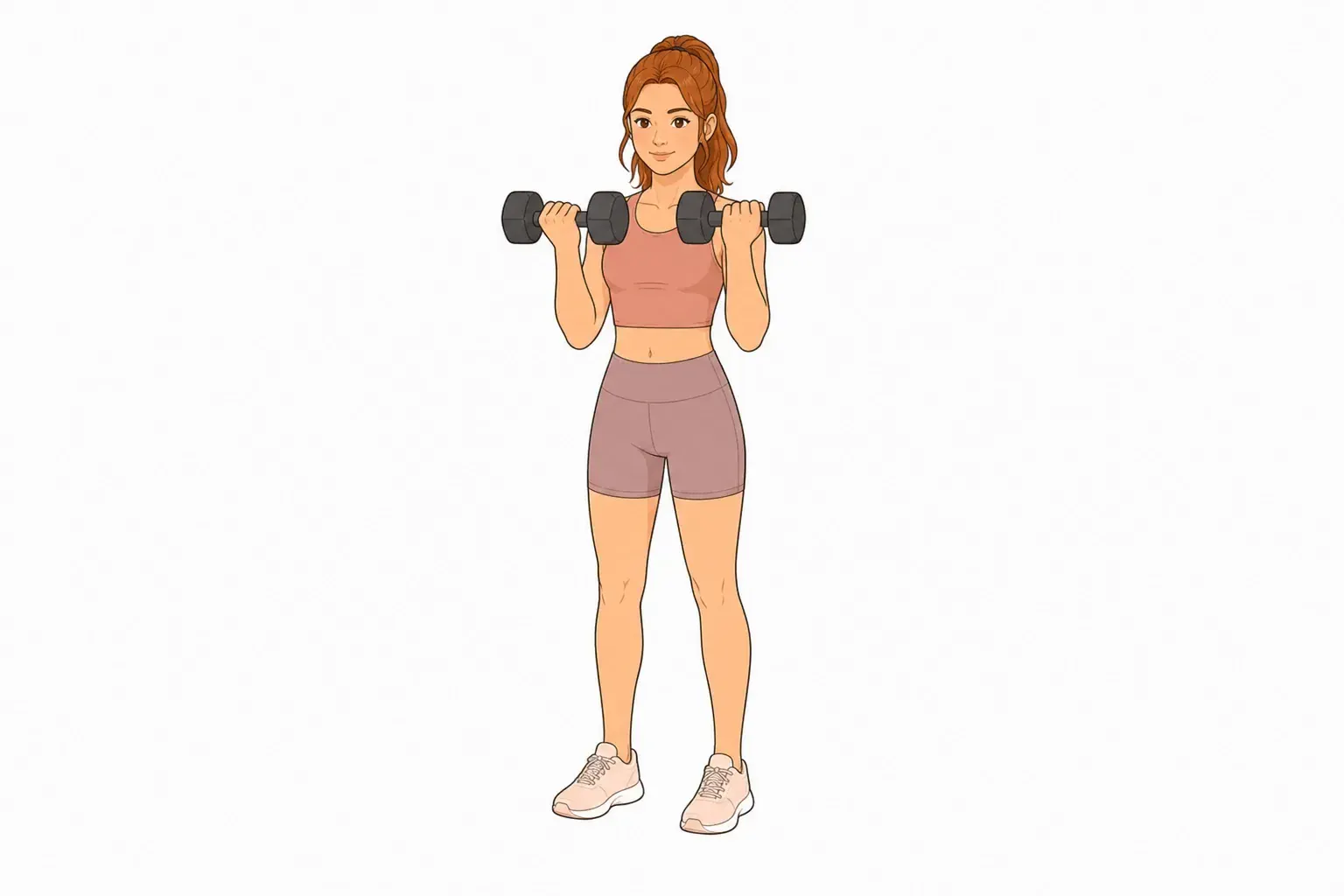

Reverse Dumbbell Curls is a beginner upper body exercise you can do using dumbbell. Below is the full movement, step by step, with the form cues and common mistakes that matter most.
At a glance
| Body area | Upper body |
|---|---|
| Difficulty | Beginner |
| Equipment | Dumbbell |
| Main muscles | Brachioradialis, biceps and brachialis |
| Movement pattern | Pull and elbow flexion |
| Steps | 2 |
Muscles worked
The work lands mainly on your brachioradialis, with your biceps and brachialis taking a share of it. That mix is what makes Reverse Dumbbell Curls worth keeping in a rotation rather than doing it once and forgetting it.
The pattern here is pull and elbow flexion. Follow it with a pushing movement in the same session and the workout stays balanced.
Pronated grip shifts emphasis toward brachioradialis (forearm muscle). Can be used as a supplementary exercise to target forearm muscles and provide variety. Minor overall difference compared to supinated grip curls, but useful for comprehensive arm development.
How to do it
Step 1
Hold a dumbbell in each hand with your palms facing down (pronated grip), arms at your sides, and elbows tucked close to your torso.

Step 2
Curl the dumbbells up toward your shoulders by bending your elbows, then lower them back to the starting position with control.

Form cues
- Keep elbows tucked close to your torso
- Stand with a neutral spine
- Engage your core lightly
- Keep your elbows stationary
- Move only at the elbow joint
- Lower the weight over 2–3 seconds
Common mistakes
Elbows drifting away from the body. Press your elbows into your sides and keep them there throughout the movement.
Shoulders hunching toward ears. Drop your shoulders down and back.
Leaning back to swing the weight. Keep your torso upright and still; let only your forearms move.
Elbows moving forward or outward. Anchor your elbows to your sides; only your forearms should move.
Jerky or uncontrolled lowering. Slow down the descent and maintain tension throughout.
Partial range of motion. Lower until your arms are nearly straight, then curl all the way up.
Breathing
- Inhale as you lower the weight.
- Exhale as you curl up.
Safety
- Use a weight that allows you to maintain control throughout the full range of motion
- Do not lock out your elbows at the bottom; keep a soft bend
Where it fits in your training
Once the last set still looks clean, Bodyweight Mid Row is the next step up in the same pattern. For a change at the same level, swap in Neutral Grip Curl.
Related exercises
More upper body movements in the Reel Motion library:
- Barbell Curl — beginner
- Dumbbell Curl — beginner
- Chin-Up — beginner
- Inverted Row with Straps — beginner